
The day the animals behaved like humans
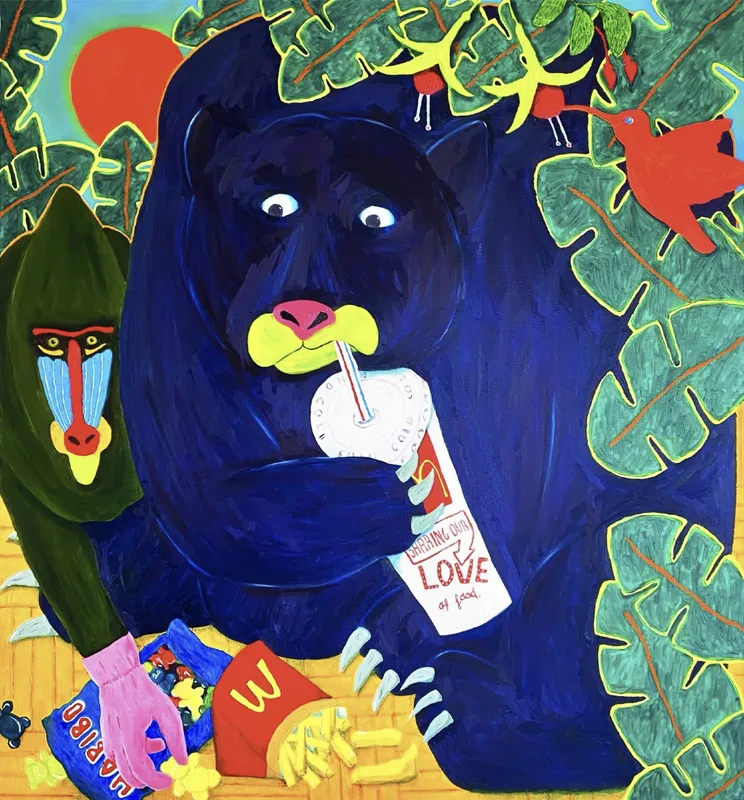
Miguel Ángel Cazo’s painting begins with memory, understood not as a faithful record of the past but as a shifting territory where recollections transform over time. Born in Móstoles in 1974 and largely self-taught, his trajectory has moved through photography, television, graphic design and ceramics before focusing fully on painting—experiences that have shaped a direct, intuitive and deeply personal visual language.
In The Day the Animals Behaved Like Humans, Cazo presents a series of scenes in which animals adopt gestures and attitudes characteristic of human behavior. Through this subtle inversion of roles, the artist introduces a distance that allows us to observe our own social dynamics from another perspective. Attitudes and behaviors that we often perceive as normal in human society appear unexpectedly absurd when embodied by animals. This displacement creates a moment of recognition: by seeing these actions reflected in other species, we are invited to reconsider the logic—and sometimes the irrationality—of our own conduct.
Executed in oil and acrylic on canvas, the paintings are built through color as both a structural and emotional element. References to the urban visual culture that shaped the artist’s early years coexist with a loose figurative language that prioritizes expressive intensity over descriptive precision. Each scene unfolds like an open narrative in which the intimate and the collective intersect.
This exhibition, Miguel Ángel Cazo’s first with Galería Isolina Arbulu, brings together a body of work that moves between memory, observation and imagination. In these paintings, animals become a displaced mirror through which we can look again at what we call human—revealing, with a subtle sense of irony, how fragile and sometimes contradictory our own behaviors can be.

